Bakunin 86
Ciza Muzej
Roulotte
Canòdrom/Canòdrom
ON Prat
Rieres/Rambles
Singuli. The Paper City
2026
A project by Domènec, based on a proposal by Martí Peran.
Part of the exhibition “Singuli. The Idiot City. An Anarchist Architecture Program,” curated by Martí Peran with the collaboration of Domènec.
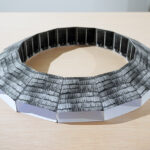
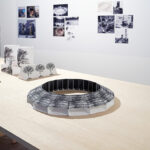
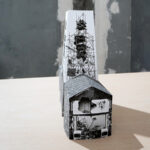
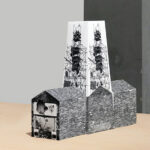
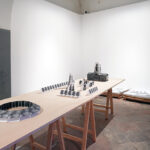
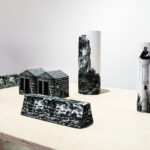
Singuli. The Paper City
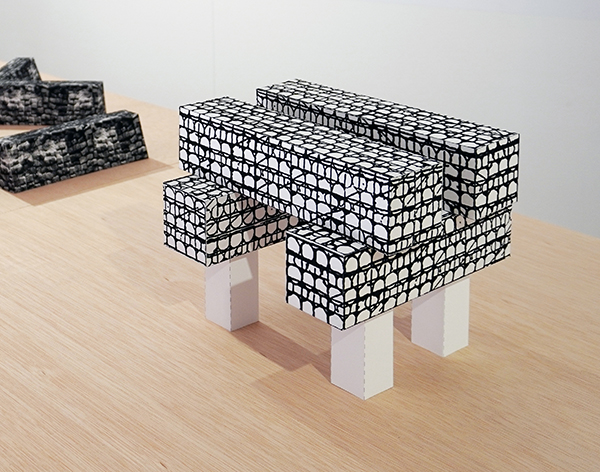
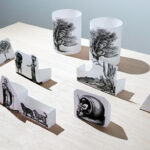
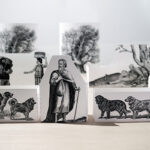
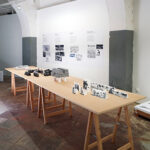
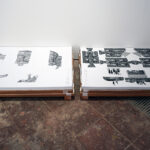
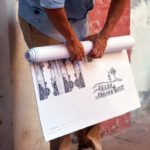
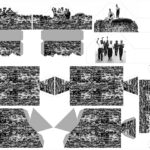
9 paper “cities”: 9 paper models and 9 posters (70 x 100 cm each) featuring cut-out models to take home (edition 750 copies of each).
A production by M/A/C Mataró Art Contemporani
01/ Singuli
Singuli does not exist and yet it is not strictly speaking a utopia, since its true nature is conceptual. No architect or engineer has ever visited Singuli. Singuli is the Latin term denoting the “one” included in “each”, that is, that singular instance that, despite this, coexists within a shared framework populated by other “units”. It is because of this tension – so complex and, at the same time, so simple to understand – that Singuli could be the place name of that city (polis) constituted by the im-political subjects (idiotikós). The impossible an-archist city. The notion of Singuli, venturing into these domains, was proposed by Jean-Luc Nancy in 1996 in his book Being Singular Plural (Être singulier pluriel).
02 / Temptatives. Fernand Deligny
Fernand Deligny worked with autistic children in various places: in Armentières, between 1939 and 1943; through the network La Grande Cordée, between 1948 and 1962, and finally in the Cévennes from 1969 to 1986. In all these places, he encouraged the formation of what he called “singular ethnic groups”, communities of peers where one could “simply be” without the need for mediation through language. He also referred to these places as “temptatives”: an attempt to bypass ideologies, moral imperatives, and norms. An attempt only survives if no goal is set, even when it is inevitably asked to achieve one.
03 / Barricades. Federation of Barricades, Barcelona, 1936
When the Fascist uprising took place in 1936, barricades were immediately erected throughout the city on the initiative of the trade unions, political parties, neighbourhood organisations and ordinary citizens who took up arms and formed the Federation of Barricades, an organ of urban power around which the resistance would turn during those first weeks. The barricades served not only a practical but also a symbolic function: they were class borders, they defined an alternative map of the city. In a 1873 memoir on social insurrection in Spain, Friedrich Engels wrote that Barcelona had seen “more barricade fighting than any other city in the world”. In 1937, numerous barricades would rise again to give an unexpected turn to the conflict.
04 / Junk Playground (Skrammellegeplads). Theodor Sorensen, Emdrup, Copenhaguen, 1943
In a context of growing resistance to German occupation in Denmark, the first playground made of waste materials (Skrammellegeplads) was opened in Copenhagen in 1943. Designed by landscape architect Theodor Sorensen, the space was conceived in a minimalist style, recreating the Danish countryside: “a beach, a forest, a meadow”. After a visit by Lady Allen of Hurtwood in 1946, the Emdrup playground inspired the phenomenon of so-called “adventure playgrounds”, which were created in areas of London damaged by bombs.
05 / St George’s Hill. Gerrard Winstanley / The Diggers, Weybridge, Surrey, 1649
On 1 April 1649, April Fool’s Day, when various forms of irreverence were allowed, Gerrard Winstanley and the diggers – poor day labourers without any property – occupied the public common land of St George’s Hill and began to cultivate it communally. The occupation became an experiment based on Christian communitarianism. The Diggers were also called True Levellers to distinguish themselves from the proto-democratic factions (Levellers), which they considered too moderate and which began to emerge in the English parliament.
06 / Space City. Yona Friedman, 1959-1964
“The main thesis I defend in architecture is that the central figure is not the architect, but the user of the building, the inhabitant. This inhabitant is not the “medium man” – an imaginary entity in the mind of statisticians – but a real person, an individual who is different from all others. Moreover, today they are different from who they were yesterday and who they will be tomorrow. Therefore, they have their own perception of the space available to live in: they must be able to organise it at any time and to reorganise it differently tomorrow” (Y. F.).
The Space City is a utopian proposal based on a megastructure in the form of a raised network on pillars. It represents Friedman’s idea of ‘mobile architecture’, which prioritises the role of users, who are able to modify the city according to their desires and needs.
07 / Dolly’s Tower. Claremont Road, London, 1994
A giant barricade, built with recycled materials and obvious structural precariousness, Dolly’s Tower became the main observation point during the Battle of Claremont Road, of neighbourhood resistance against the expansion of a highway outside London and in opposition to the urban policy of Margaret Thatcher’s government. For a few days in November 1994, hundreds of people participated in a creative resistance camp. The Tower was named Dolly in honour of Dolly Watson, the neighbour who refused to obey the eviction orders.
08 / Pera. Crates of Thebes, 4th century BC
Crates of Thebes (368-288 BC), according to Diogenes Laertius (DL, VI, 85), was one of the most prominent disciples of Diogenes the Cynicus. Laercius attributes to him some «folly verses» in which he describes the city of Pera as a «filthy» but «fair and fat» place, where «parasite» opportunists do not inhabit, where «garlic, figs and loaves» abound for everyone, and where «wars» and vanities are unknown. Pera – which is also the name of the knapsack where the Cynics carried their scarce belongings – refers, therefore, to this possible austere place, dedicated to detachment and to the honest and simple life that promoted classical Cynicism.
09 / Yanomami people. Amazon rainforest
Along with the Gujaquí, or Aché people, the Yanomami communities are the main model that Pierre Clastres uses to develop his thesis in The Society Against the State (La Société contre l’État, 1974).
After analysing the distribution of time and the ways of working of the Yanomami, Clastres concludes: “Men – that is, half of the population – worked for about two months every four years! They dedicated the rest of the time to activities that they did not perceive as work, but as pleasure: hunting, fishing, parties and drinking; and, finally, to satisfy their passionate taste for war.” Far from representing societies of scarcity, Yanomami produce only what is necessary, because they simply do not want to work any longer: the human being is the purpose and production, the means, inverse to our established models.